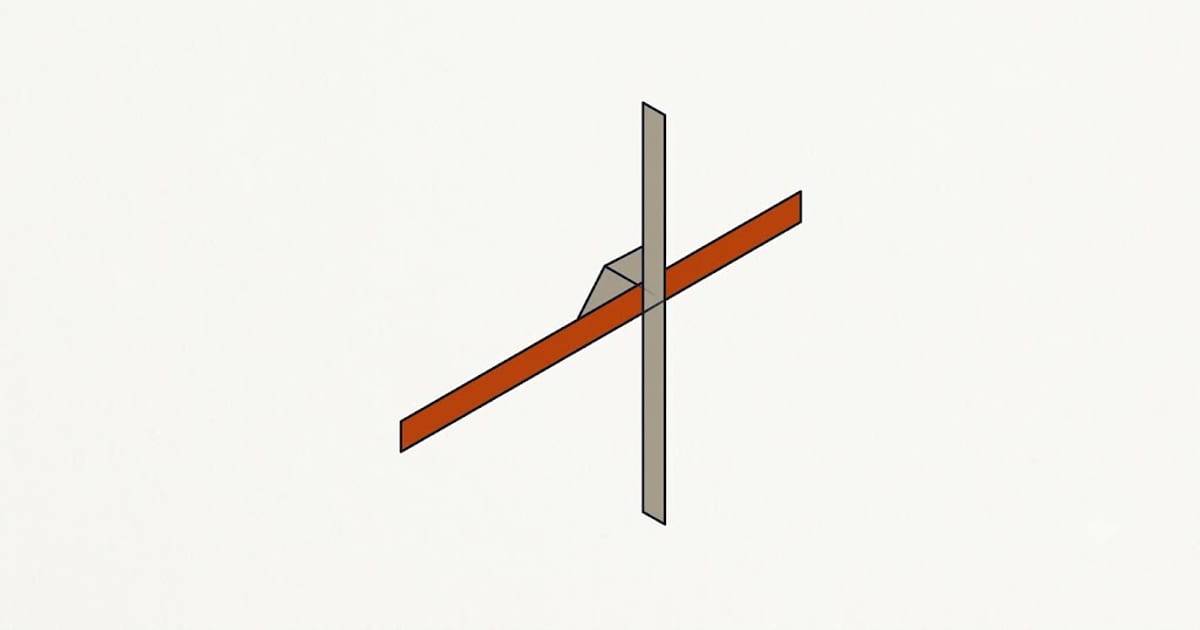
Where a sloping roof runs into a vertical wall — a dormer cheek, a porch roof against the house, a garage wall — is the hardest junction on a house to keep dry.
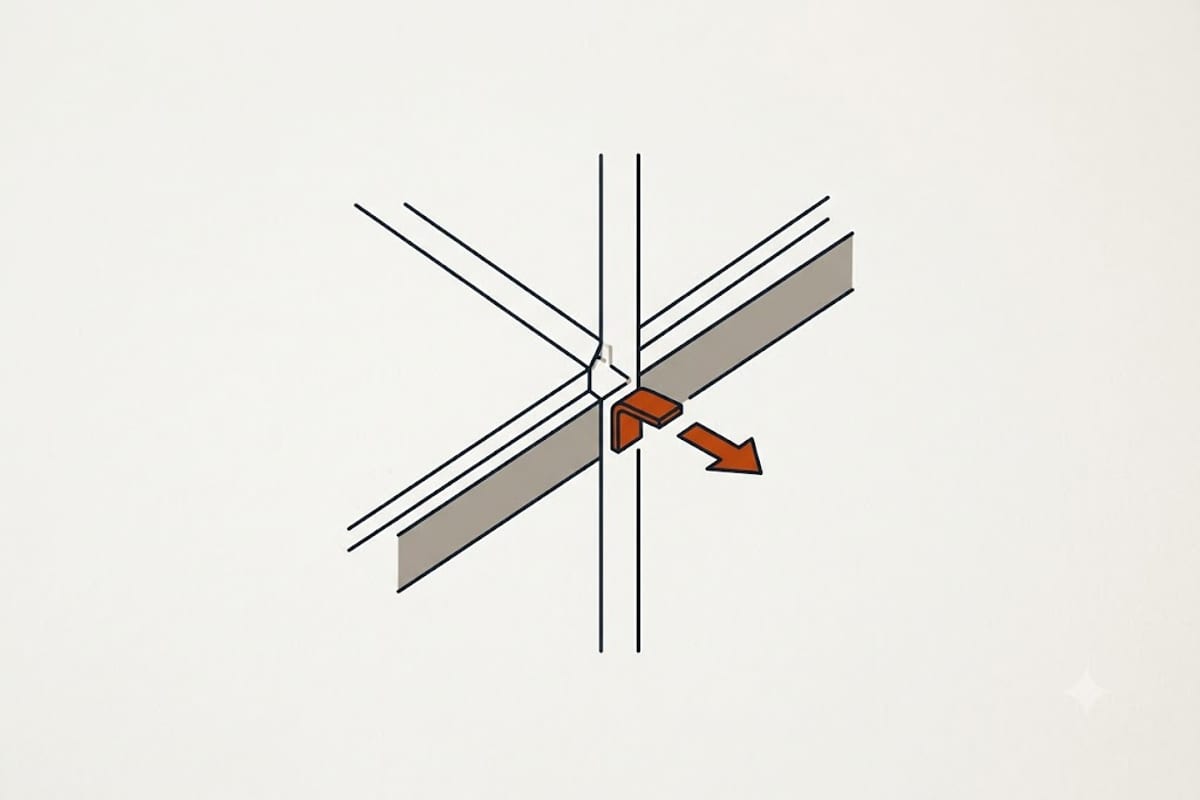
Step flashing
Individual L-shaped pieces of metal, one per shingle course, each lapping the one below.
Not a single long strip. A continuous piece cannot lap the shingles course by course, so water finds the top edge and runs behind it. Continuous flashing at this junction is a defect regardless of how much sealant is applied to it.
Each piece sits under the shingle above and up behind the wall's weather barrier, so the water path is always over the top of the next thing down.
The kickout
At the bottom of the run, where the roof edge meets the gutter, the last flashing piece is bent outward to throw water away from the wall and into the gutter.
Without it, everything the roof plane collects along that whole run arrives at the bottom corner and goes straight down inside the wall.
This is one of the most common omissions in residential construction and one of the most destructive. The damage is invisible for years and then appears as rotted sheathing and framing behind an apparently sound wall.
It is a small piece of metal costing very little, and it must be fitted before the siding goes on.
Where the siding stops
The cladding does not sit on the roof. It stops above it — commonly 1 to 2 inches — so water running down the wall drips onto the roof surface rather than wicking up into the cladding.
That gap is deliberate and it must not be caulked closed. Filling it makes a wick out of the bottom edge and traps anything that gets behind.
The gap looks like an unfinished detail to an untrained eye, and it is one of the details most often ruined by a well-meaning later repair.
The order of operations
Roofing and siding are usually different trades, and this junction belongs to both. The correct order is:
- WRB on the wall, lapped down over the step flashing as it goes on
- Step flashing installed with the roofing, course by course
- Kickout at the bottom
- Siding installed to stop short of the roof
When the trades work in the wrong order, the flashing ends up on top of the WRB instead of behind it, and the whole assembly directs water inward.
What to look for on an existing house
Stand where a roof meets a wall and look at the bottom corner.
If there is no small piece of metal turning water away into the gutter, there is probably damage in that wall. Staining on the siding below the junction, or on the interior in that corner, makes it near certain.
This is worth checking on every house before any siding work is quoted, because it changes the scope.
The other junctions worth the same attention
A chimney, which needs step flashing on the sides, an apron at the front and a cricket behind it on anything but the narrowest chimney.
A deck ledger, where flashing keeps water out of the band joist. Failures here are structural rather than cosmetic.
A porch roof against the house, which is the most common place to find a missing kickout because it usually meets the wall right above a doorway.
Each is the same principle: everything laps over the thing below it, and the last piece at the bottom throws water clear of the wall.
Sealant is not flashing
A junction that relies on caulk is a junction with a service life measured in years rather than decades.
Sealant belongs as a secondary measure on top of correct lapping, never as the thing keeping water out.